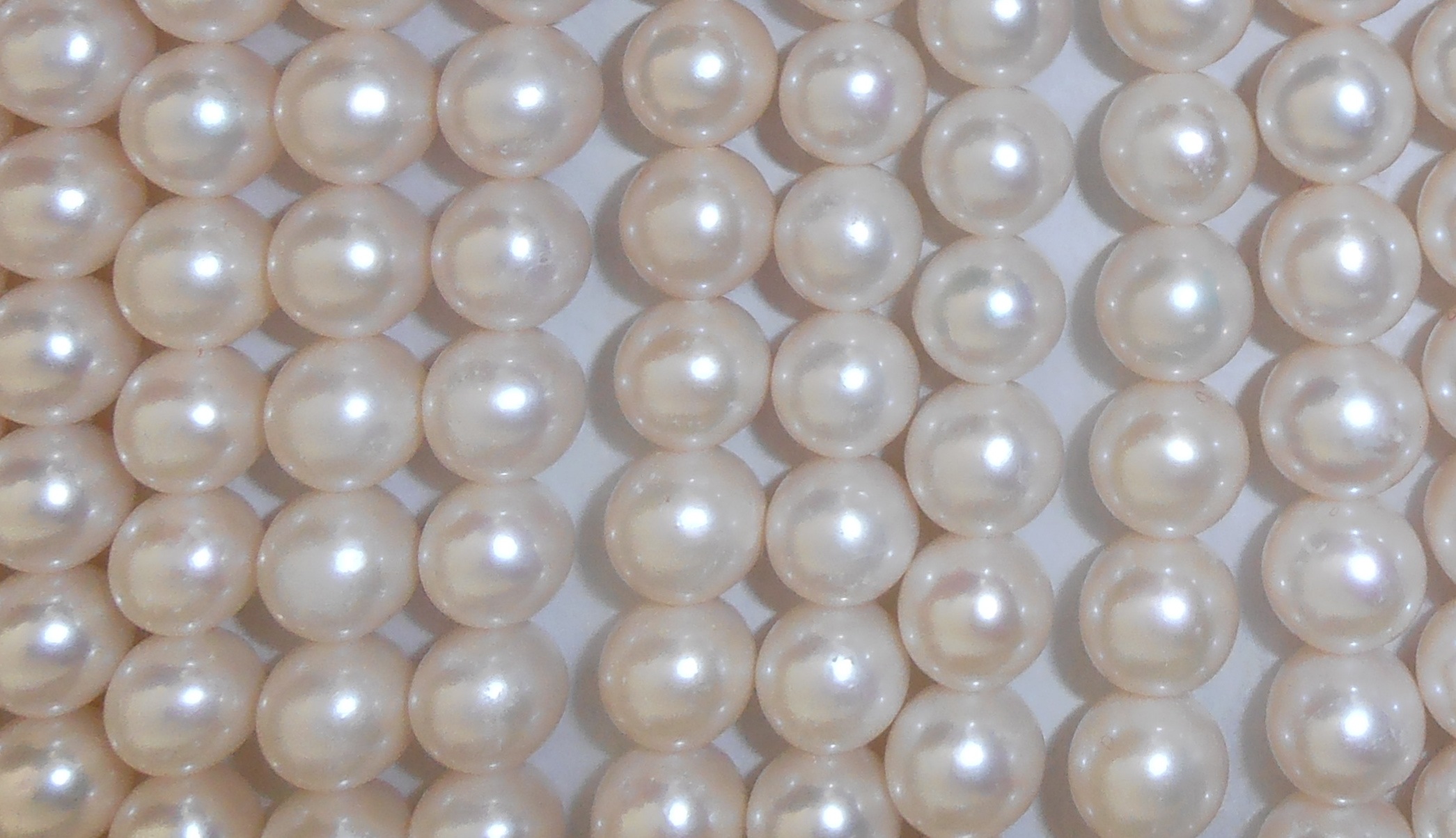
One of the great innovations in perlculturing –pearl farming, a bit like fish-farming, has its own terminology– has been the introduction of non-white, non-cream cultured freshwater pearls. A generation ago most people would have automatically said a pearl had to be white or, possibly, cream. In fact, there has always been a bit more variety in pearls than that.
Today “novelty” pearls are big business. Freshwater pearl culturing operations are now producing literally tons of pearls in a wide variety of qualities and colors. Some of these colors are natural, some have been treated.
Interestingly some of the most beautiful “novelty colors” –colors that people assume must be treated– are often natural.
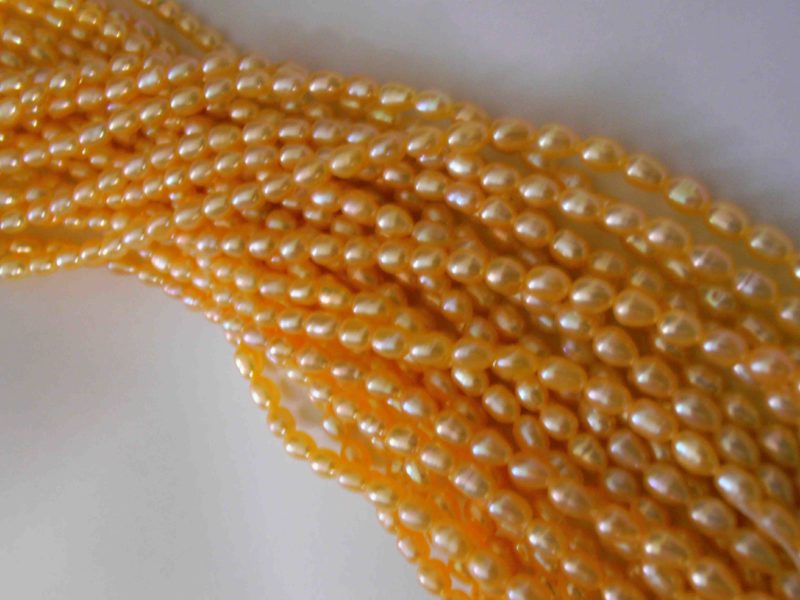
The nacre of these cultured freshwater pearls is far from the best… However this hank displays the variety of naturally occurring “fancy” shades of pink, peach and salmon that can occur in freshwater pearls produced by some pearl farms.
Freshwater pearls are NEVER naturally purple, red, black or brown. (Some saltwater pearls –primarily Tahitian Pearls can be black. And some incredibly rare and costly pearls produced by univalves –mainly Conchs– can be a beautiful flame pink or orange. These pearls are so rare that you will probably never see a matched pair let alone a strand. Instead they are used as the centerpieces of one-of-a-kind jewels.)
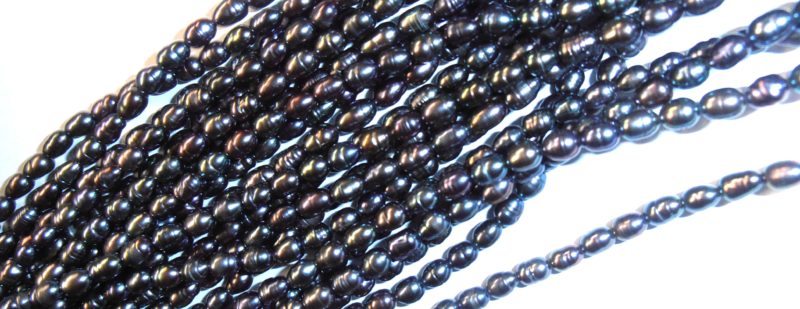
Cultured Freshwater Pearls are never naturally black, grey or “peacock.” These cultured freshwater pearls have been irradiated to give them a faux “Tahitian” look.
But cultured freshwater pearls can naturally be salmon, peach, blush or even slightly lavender.
These small “potato” shape cultured freshwater pearls are naturally a peachy color. Similar pearls can be salmon, cream, white or a very pale pink.
Sadly most of the fancy colored pearls on the market that are naturally pink, peach or (slightly) lavender aren’t well marked and the retail buyer is left to wonder what color is natural. The ubiquity of some of the treated pearls –and the very “fake” appearance of some of the dyes– have mistakenly led many people to assume that if it isn’t white or cream it has been treated. In reality, it is hard to tell. Some fakes are easy to spot. For instance NO freshwater cultured pearl is naturally black, grey or peacock. If you want a cultured pearl with natural dark tones you will almost certainly have to buy cultured saltwater Tahitian pearls –or similar pearls from Fiji or the Philippines.
If you love pastel colors –peach, salmon, blush, even a lavender overtone– you will have loads of naturally colored cultured freshwater pearl options.
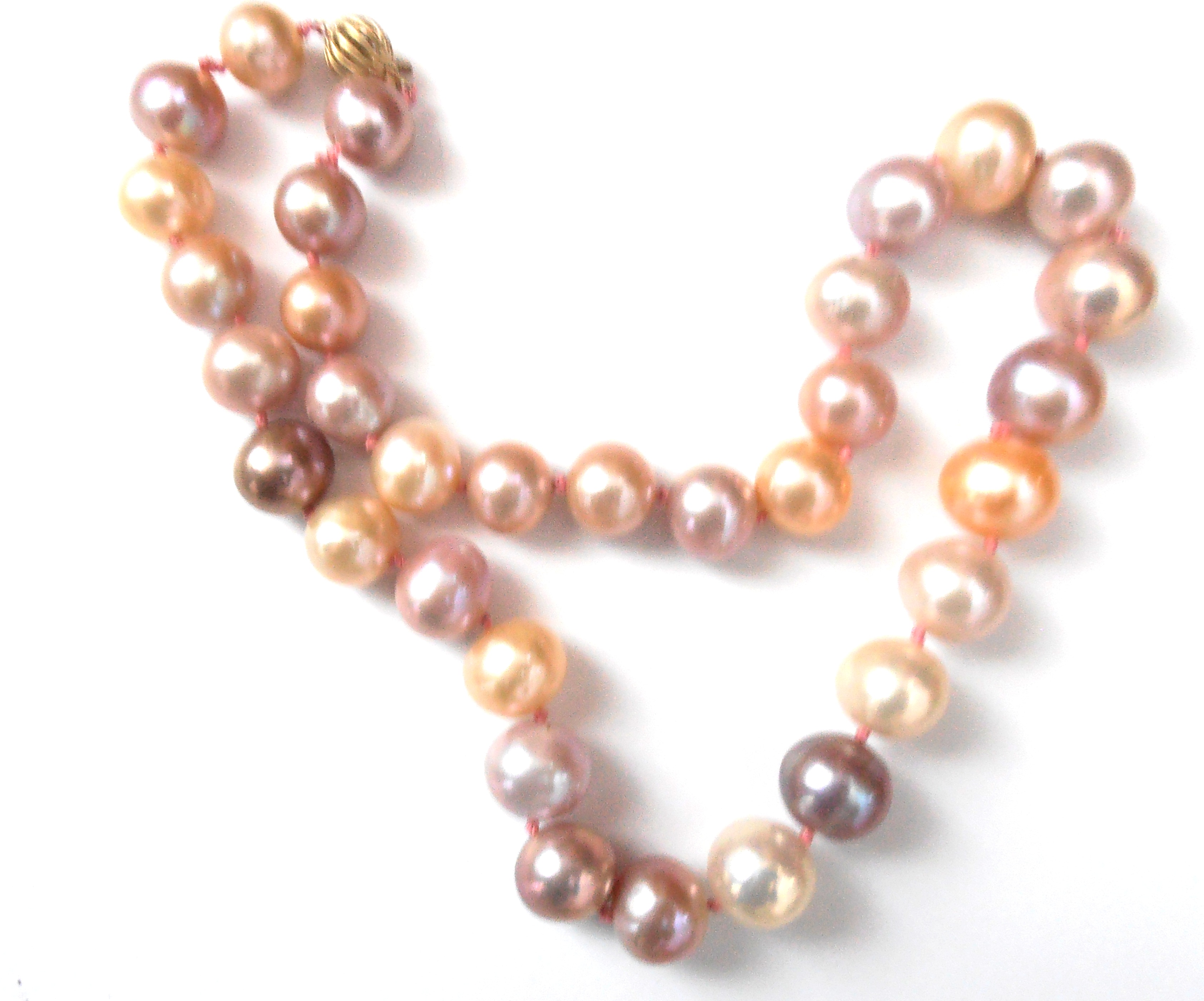
This custom necklace consists of a mixed collection of “fancy color” shell nucleated cultured freshwater pearls. All of the colors are natural.
And if you love yellow but don’t love the near mustard shades available in some dyed pearls you have a few other options as well.
But if you love pastels… if you love “overtones” –“overtones” are what we call the shimmer of color on a pearl with a more muted bodycolor, a lavender overtone on a white or cream pearl can be truly stunning– the world of cultured freshwater pearls has a near rainbow of naturally occurring colors.
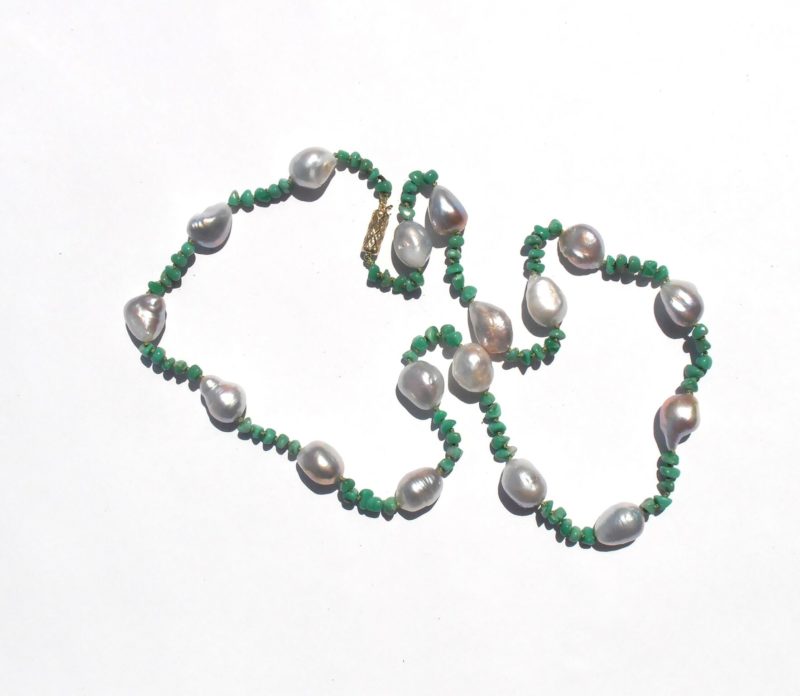
This one-of-a-kind necklace features irregular Baroque freshwater pearls with a white bodycolor and lavender and bluish overtones. The colors are all natural.
Pearls gathered in hanks can be matched to make collars, Matinee Strands, or even go to the Opera…
Words have a habit of outlasting the things they describe sometimes. When was the last time you actually dialed a phone? Or hung up a phone? We’ve cut the cord, dumped the dials and yet… the words live on like a broken strand of pearls rolling across the floor.
Jewelry is full of phrases like that. Phrases that have lived on because they meant something once. Phrases that in a way still mean something, but aren’t really rooted in a world we live in anymore. Blame fashion, blame changing fashions… Blame the fact that fashion helps sell jewelry, but a good piece of jewelry –and even a not so good piece of jewelry– can outlast any fashion. And so we come to the twenty-first century. We sell pearls to women who plan on wearing them with their bluejeans –because it is better than never wearing pearls at all– and yet… the words we use to describe those pearls were mainly standardized before movies had sound.
Classic near-round pearls… pick your length!
Think about that for a minute. Forget the digital revolution, forget the Space Age, forget the New Look, the Second World War, the New Deal… forget it all. March back to an era of black and white photographs, atlases you unfolded across your knees to find Japan and the home of the lustrous beautiful delicate white pearls that revolutionized the jewelry world almost a hundred years ago today, and it is there, and there alone, that terms like Matinee Length, Princess, Opera, Choker and Collar begin to make sense.
Ignore the romance and the history for a few minutes and let us get down to the nitty-gritty inch based facts of the matter for a few seconds.
An “Opera Length” strand of pearls is traditionally a loop anywhere from 28 to 34” long.
A “Matinee Length” strand of pearls –occasionally known as an “afternoon length”– is traditionally a loop anywhere from 20 to 24” long.
A “Princess Length” strand of pearls is traditionally a loop anywhere from 17 to 19” long.
A “Choker Length” strand of pearls is traditionally a loop anywhere from 14 to 16” long.
A “Collar Length” strand of pearls is traditionally a loop anywhere from 12 to 13” long.
Reality has a way of making rules seem a little out of touch though. Traditionally “Opera Length” had nothing to do with inches and everything to do with the fact that it was usually the longest length available. I have seen 62” strands of pearls referred to as “Opera Length” –gorgeous, eye catching, and technically an unromantic “Rope” of pearls. Collar and Choker are also variable terms these days because one woman’s “Collar Length” strand of pearls could literally choke another woman.
A better rule of thumb has to do with the way a necklace is worn. Basically, anything between 12 and 16” is usually meant to be worn next to the skin. (Those lengths usually aren’t long enough to be worn over a collar.) The Princess Length was briefly re-marketed as a “Businesswoman’s Length” in the 1980s –conservative and classy, it was chic when paired with a turtleneck and blazer for the classic ‘80s look.
These days we generally use both a term and an inch length to describe our pearl necklaces. But we are glad the old terms endure… because I am sure if we made up new terms today they would be utterly meaningless in another hundred years.
In German “Perl” is used as a synonym in the jewelry industry for any bead… “Pearl Lengths” don’t just refer to pearl necklaces!
We all want to be unique. Failing that we all want our things to be unique. At least that seems to be the conclusion marketing gurus came to a few years ago. Lately it seems that the drive to label things unique —or custom, or limited edition, or “couture” or whatever the catchphrase of the minute is— has become a compulsion completely divorced from reality.
My enough-is-enough moment came during rush hour on the interstate. At 10mph you have a lot of time to read billboards. Worse, you have a lot of time to really think about what the billboards mean. I won’t torture you with all the details —the sun beating through the windshield, the minivan driver convinced that persistent honking could just make a few thousand other vehicles disappear— suffice it to say I had a lot of time to stare at a billboard for a chain offering “personalized” burgers. Yep. Personalized burgers. Personalized mass produced burgers. Apparently being able to request onions or no onions makes it “personal.”
Now I don’t know about you but I have always thought that “personal” is, well, personal. Ditto unique. And as for customized? For something to be truly custom it should be at least a little more customized than a selection of options chosen from a narrow menu shared with a few million other people.
I’ve always thought that jewelry is the most personal object most people will ever buy or wear. (You could probably make the argument that jewelry that is received as a gift is doubly personal… but it probably depends on the circumstances of the gift.) And yet… these days an awful lot of jewelry isn’t much more custom, unique or personalized than a t-shirt.
I grew up in the jewelry world and I have worked making mass produced jewelry and I will never dismiss or demean the value of “commercially produced” jewelry. Mainly because I understand the parameters that limit and define what you can do if you are making 500 necklaces or 2,000 bracelets or 20,000 rings for that matter. Quite simply it isn’t just about price. In the world of jewelry design volume is as much of a limiting factor as cost. If you are mass producing a design the cost of the materials will limit what you can do, but the volume of materials you require will also limit what you can do. Sometimes it doesn’t matter how much money you can afford to spend, you just won’t find 20,000 identical stones in a particular size, color or quality.
The natural world is the mother of “unique.” Any given gem source has the potential of producing the good, the bad, the ugly and the incredibly beautiful. And all within the course of the same year. The natural world is about variety. Mass production is about consistency.
Personally I love consistency —for certain things. I also love variety. Most of all I love honesty. I also think people who want something unique should have the option of having something that is really unique, personal, collectible, maybe even, gasp, custom! So I’ll make you a deal. I promise that every single strand of beads on our website really is rare or unusual for some reason (or really really pretty) and that every single one of our Finished Necklaces really is one of a kind.
Yes, one of a kind. Not one of five hundred, or ten thousand or even one of fifty. One of a kind. Completely unique. Just like you there will be only one. And you’ll promise to have a bit of compassion next time you see a woman having a mini-meltdown when someone asks her if she’d like her ice-tea “customized” with a wedge of lemon. Deal?