Tag: History

  • Happy Birthday February –Amethyst the February Birthstone…

    Happy Birthday February –Amethyst the February Birthstone…

    Amethyst, the February Birthstone, sometimes seems like the stone jewelers have been using forever. It is a “staple” of the jewelry industry… And, like any staple, anything that is always there, beautiful but in the background, Amethyst often doesn’t get the respect it deserves. But Amethyst isn’t just a staple of the jewelry industry, it is more like that lost Old Master hanging in a shadowy hallway at grandma’s house. Not forgotten exactly, but under appreciated until a stranger stops in shock at the wonder of it.

    So perhaps we owe Amethyst –and all the February babies– the honor of taking a look at our old friend Amethyst with a stranger’s eyes.

    From a scientific point of view there is nothing spectacularly odd about the origin of Amethyst. Amethyst is a Quartz. A Silicate. (Silica is one of the most common minerals on Earth, and it is also one of the most useful substances on Earth.) By definition Amethyst is the purple Quartz. If it is Quartz and it isn’t purple (or at least slightly purplish) it is not Amethyst. By definition there is no such thing as “Green Amethyst.” (If it isn’t purple it has a different name… For instance, “Yellow Quartz” is Citrine.)

    Because Amethyst is a Quartz and can thus be found in many different locations throughout the world, Amethyst has an old history of use in jewelry and over the past three thousand years has been set in expensive “Court Parures” as well as more everyday pieces (for those of us who do not socialize with the Emperor Napoleon’s well-dressed sisters).

    Amethyst can be either a dark rich purple or a lighter shade of lavender. The February Birthstone was used in jewelry for centuries before faceting became common. The elongated barrel shaped Amethyst beads in the necklace are reminiscent of the beads made and worn by the Ancient Egyptians of Cleopatra's Age.
    Amethyst can be either a dark rich purple or a lighter shade of lavender. The February Birthstone was used in jewelry for centuries before faceting became common. The elongated barrel shaped Amethyst beads in the necklace are reminiscent of the beads made and worn by the Ancient Egyptians of Cleopatra’s Age.

    While Amethyst was used by Egyptians for centuries before Rome grew into a mighty Republic (and then an even mightier Empire), it is the Greeks and the Romans who gave Amethyst its origin story. To the Romans Amethyst was a beautiful girl who had dedicated herself to Artemis, Virgin Goddess of the Hunt, Protectoress of the Innocent. To escape the unwanted attentions of the lecherous Dionysius, God of Wine, Amethyst begged her Protectoress to make her untouchable. Artemis obliged by the beautiful girl by turning her into a clear piece of Quartz. Supposedly the God of Wine, guilt stricken that his unwanted attentions had driven the pure Amethyst to such desperate measure poured a libation of purple wine over the clear Quartz and gave Amethyst her color for all time.

    Whether Amethyst was ever a beautiful girl it is not our place to say. But Amethyst is still a uniquely beautiful stone.

    The dark beauty of Amethyst makes it an ideal "mixer" stone for multi-color jewelry. During the 1890s in the United States and Britain jewelry incorporating Amethyst, Emeralds and Pearls became a popular and discreet way for ladies to signal their commitment to women's suffrage. In the language of stones Green (Emerald), Violet (Amethyst) and White (Pearls) spelled "Give Votes to Women."
    The dark beauty of Amethyst makes it an ideal “mixer” stone for multi-color jewelry. During the 1890s in the United States and Britain jewelry incorporating Amethyst, Emeralds and Pearls became a popular and discreet way for ladies to signal their commitment to women’s suffrage. In the language of stones Green (Emerald), Violet (Amethyst) and White (Pearls) spelled “Give Votes to Women.”

    We think Amethyst in all its glory is still a wonderful choice for jewelry. And a perfect February Birthstone –and gift– for all the February babies out there.

    While we love the beauty of cut and faceted Amethyst... even in its "raw" form Amethyst is beautiful. This necklace features spheres of polished Turquoise and unpolished "raw" Amethyst points.
    While we love the beauty of cut and faceted Amethyst… even in its “raw” form Amethyst is beautiful. This necklace features spheres of polished Turquoise and unpolished “raw” Amethyst points.

    Looking for some gift ideas for the February baby in your life? You may want to consider our one of a kind Royal Beauty and Rough Amethyst Necklace or our Rough Amethyst and Lapis Lazuli one-of-a-kind necklace.
  • Words, Pearls and Inches

    Words, Pearls and Inches

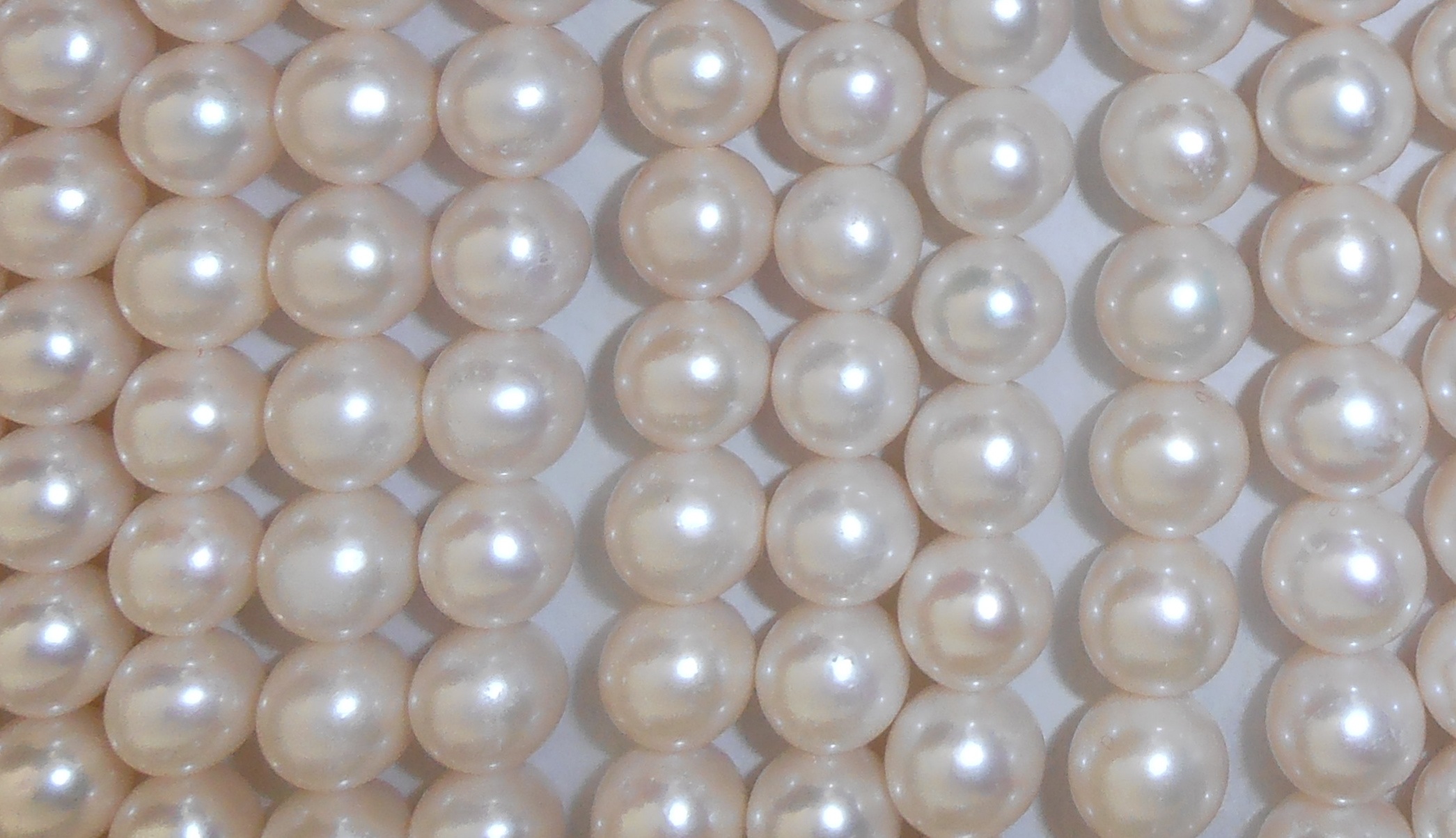
    Pearls gathered in hanks can be matched to make collars, Matinee Strands, or even go to the Opera...
    Pearls gathered in hanks can be matched to make collars, Matinee Strands, or even go to the Opera…

    Words have a habit of outlasting the things they describe sometimes. When was the last time you actually dialed a phone? Or hung up a phone? We’ve cut the cord, dumped the dials and yet… the words live on like a broken strand of pearls rolling across the floor.

    Jewelry is full of phrases like that. Phrases that have lived on because they meant something once. Phrases that in a way still mean something, but aren’t really rooted in a world we live in anymore. Blame fashion, blame changing fashions… Blame the fact that fashion helps sell jewelry, but a good piece of jewelry –and even a not so good piece of jewelry– can outlast any fashion. And so we come to the twenty-first century. We sell pearls to women who plan on wearing them with their bluejeans –because it is better than never wearing pearls at all– and yet… the words we use to describe those pearls were mainly standardized before movies had sound.

    Classic near-round pearls... pick your length!
    Classic near-round pearls… pick your length!

    Think about that for a minute. Forget the digital revolution, forget the Space Age, forget the New Look, the Second World War, the New Deal… forget it all. March back to an era of black and white photographs, atlases you unfolded across your knees to find Japan and the home of the lustrous beautiful delicate white pearls that revolutionized the jewelry world almost a hundred years ago today, and it is there, and there alone, that terms like Matinee Length, Princess, Opera, Choker and Collar begin to make sense.

    Ignore the romance and the history for a few minutes and let us get down to the nitty-gritty inch based facts of the matter for a few seconds.

    An “Opera Length” strand of pearls is traditionally a loop anywhere from 28 to 34” long.

    A “Matinee Length” strand of pearls –occasionally known as an “afternoon length”– is traditionally a loop anywhere from 20 to 24” long.

    A “Princess Length” strand of pearls is traditionally a loop anywhere from 17 to 19” long.

    A “Choker Length” strand of pearls is traditionally a loop anywhere from 14 to 16” long.

    A “Collar Length” strand of pearls is traditionally a loop anywhere from 12 to 13” long.

    Reality has a way of making rules seem a little out of touch though. Traditionally “Opera Length” had nothing to do with inches and everything to do with the fact that it was usually the longest length available. I have seen 62” strands of pearls referred to as “Opera Length” –gorgeous, eye catching, and technically an unromantic “Rope” of pearls. Collar and Choker are also variable terms these days because one woman’s “Collar Length” strand of pearls could literally choke another woman.

    A better rule of thumb has to do with the way a necklace is worn. Basically, anything between 12 and 16” is usually meant to be worn next to the skin. (Those lengths usually aren’t long enough to be worn over a collar.) The Princess Length was briefly re-marketed as a “Businesswoman’s Length” in the 1980s –conservative and classy, it was chic when paired with a turtleneck and blazer for the classic ‘80s look.
    These days we generally use both a term and an inch length to describe our pearl necklaces. But we are glad the old terms endure… because I am sure if we made up new terms today they would be utterly meaningless in another hundred years.

    In German "Perl" is used as a synonym in the jewelry industry for any bead... "Pearl Lengths" don't just refer to pearl necklaces!
    In German “Perl” is used as a synonym in the jewelry industry for any bead… “Pearl Lengths” don’t just refer to pearl necklaces!