Pearls are, traditionally the most popular birthstone for the month of June.
Want to learn more about the different types of pearls? Cultured? Natural? Freshwater? Saltwater? Tahitian? Click on the picture to read our quick and easy guide to the basics of pearls.
Ironically Pearls are not a stone. Or a gem. To be exact a pearl is a gemmoid. An organic product formed by a mollusk. A true “gem” is by definition inorganic.
As is the case with most “birthstones” Pearls have never been the sole “traditional” birthstone for the month of June. Until relatively recently –think 1910s– cultured pearls were NOT widely available and natural non-farm-raised pearls were wildly expensive. A good set of pearls in the late 1890s was literally equivalent in value to a Manhattan mansion. Not a townhouse, a mansion.
So in the 19th century milky-white Moonstones and creamy Chalcedony were popular as birthstones.
These Cultured Grey Tahitian Pearls offer a “different” look for the woman who doesn’t want basic white. (Although, to be fair, we have never thought there is anything “basic” about creamy white pearls.)
Today pearls are truly accessible. Lovely. Traditional. Wild. Modern. Whatever style you want a pearl can suit your personal style.
We love pearls, we are in a minor sort of way, pearl people. So we’ve written about pearls before. If you are interested in learning more about pearls be sure to browse our full website. And if you are interested in color check out this blog post from the Fall of 2016.
One of the great innovations in perlculturing –pearl farming, a bit like fish-farming, has its own terminology– has been the introduction of non-white, non-cream cultured freshwater pearls. A generation ago most people would have automatically said a pearl had to be white or, possibly, cream. In fact, there has always been a bit more variety in pearls than that.
Today “novelty” pearls are big business. Freshwater pearl culturing operations are now producing literally tons of pearls in a wide variety of qualities and colors. Some of these colors are natural, some have been treated.
Interestingly some of the most beautiful “novelty colors” –colors that people assume must be treated– are often natural.
The nacre of these cultured freshwater pearls is far from the best… However this hank displays the variety of naturally occurring “fancy” shades of pink, peach and salmon that can occur in freshwater pearls produced by some pearl farms.
Freshwater pearls are NEVER naturally purple, red, black or brown. (Some saltwater pearls –primarily Tahitian Pearls can be black. And some incredibly rare and costly pearls produced by univalves –mainly Conchs– can be a beautiful flame pink or orange. These pearls are so rare that you will probably never see a matched pair let alone a strand. Instead they are used as the centerpieces of one-of-a-kind jewels.)
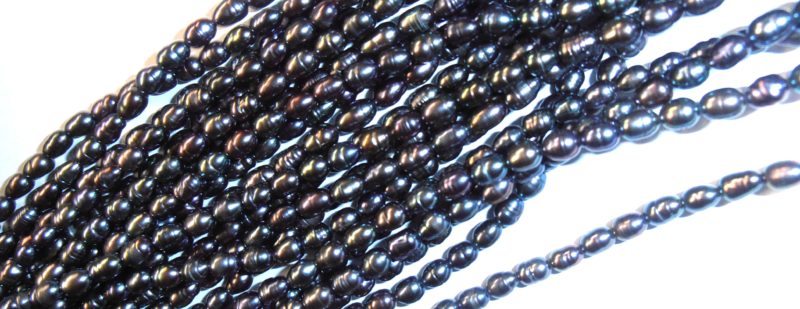
Cultured Freshwater Pearls are never naturally black, grey or “peacock.” These cultured freshwater pearls have been irradiated to give them a faux “Tahitian” look.
But cultured freshwater pearls can naturally be salmon, peach, blush or even slightly lavender.
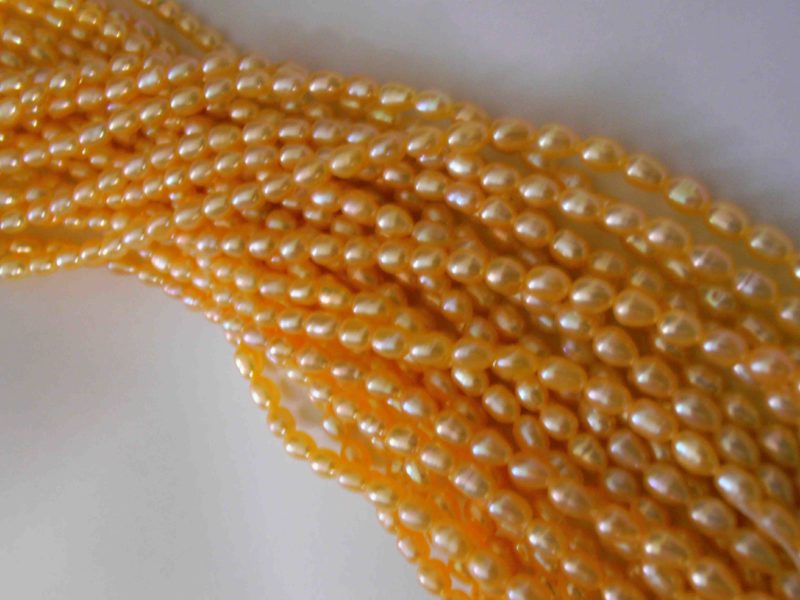
These small “potato” shape cultured freshwater pearls are naturally a peachy color. Similar pearls can be salmon, cream, white or a very pale pink.
Sadly most of the fancy colored pearls on the market that are naturally pink, peach or (slightly) lavender aren’t well marked and the retail buyer is left to wonder what color is natural. The ubiquity of some of the treated pearls –and the very “fake” appearance of some of the dyes– have mistakenly led many people to assume that if it isn’t white or cream it has been treated. In reality, it is hard to tell. Some fakes are easy to spot. For instance NO freshwater cultured pearl is naturally black, grey or peacock. If you want a cultured pearl with natural dark tones you will almost certainly have to buy cultured saltwater Tahitian pearls –or similar pearls from Fiji or the Philippines.
If you love pastel colors –peach, salmon, blush, even a lavender overtone– you will have loads of naturally colored cultured freshwater pearl options.
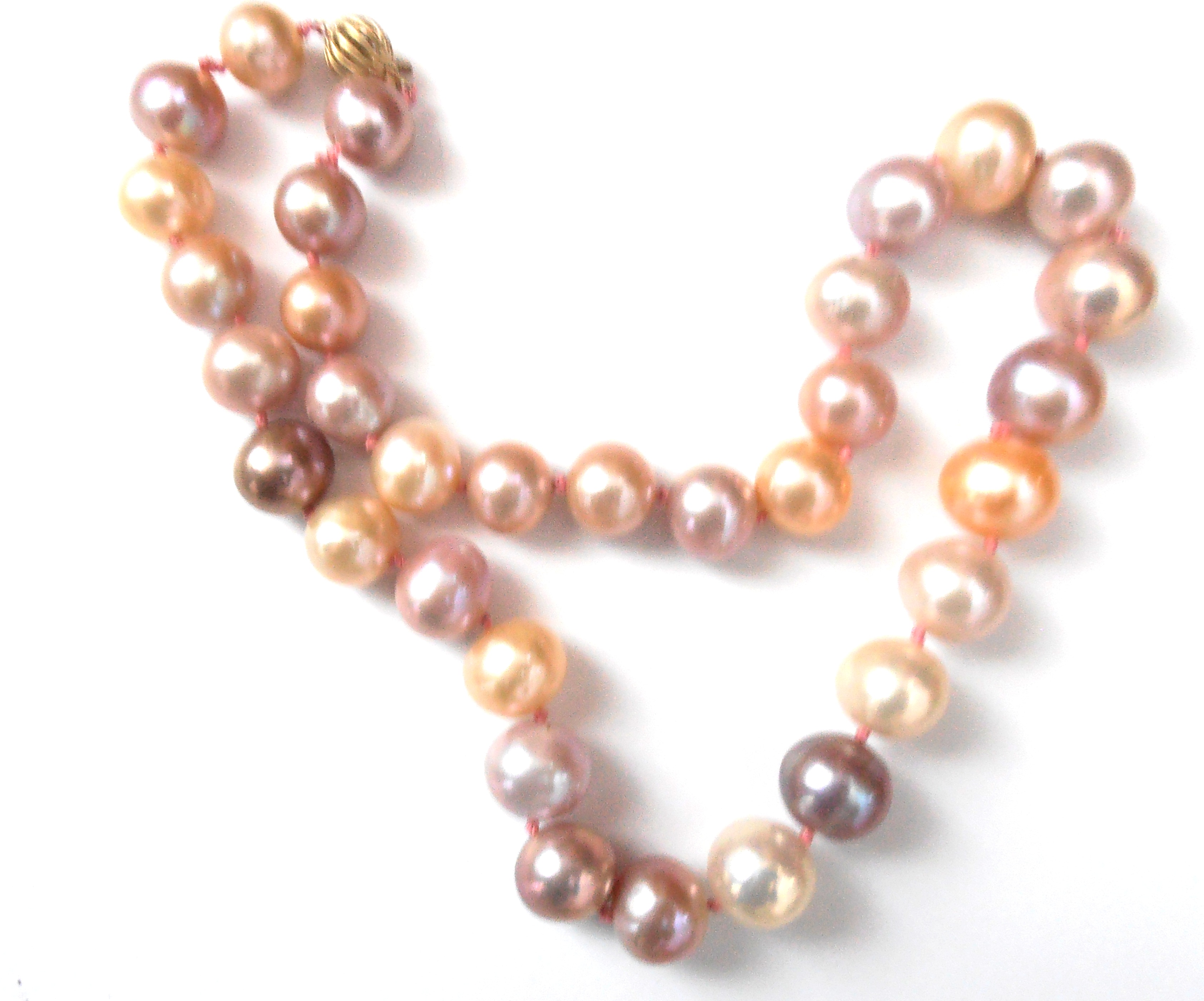
This custom necklace consists of a mixed collection of “fancy color” shell nucleated cultured freshwater pearls. All of the colors are natural.
And if you love yellow but don’t love the near mustard shades available in some dyed pearls you have a few other options as well.
But if you love pastels… if you love “overtones” –“overtones” are what we call the shimmer of color on a pearl with a more muted bodycolor, a lavender overtone on a white or cream pearl can be truly stunning– the world of cultured freshwater pearls has a near rainbow of naturally occurring colors.
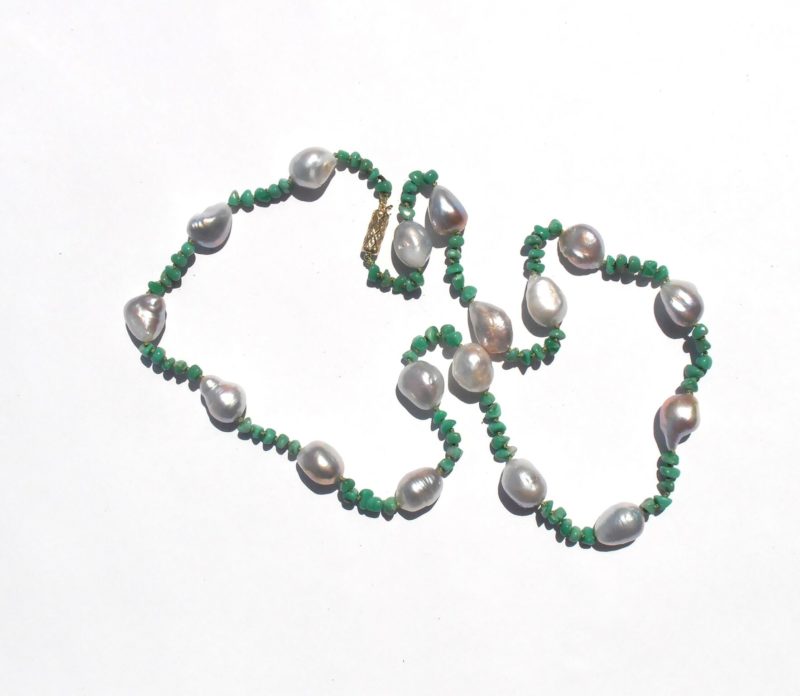
This one-of-a-kind necklace features irregular Baroque freshwater pearls with a white bodycolor and lavender and bluish overtones. The colors are all natural.