Peridot is the traditional birthstone for the month of August. The gem quality variety of Olivene, this lovely green stone has been associated with late Summer birthdays for centuries.
Ranging in color from a deep almost soulfully murky green to a light bright Spring grass green Peridot is one of the most refractive of the green gems. (There are other more refractive green gems, but many are rare, or rare in good quality sized stones.)
I often think that Peridot is the perfect green for a jeweler because it is, in general, a shade of green that can look good with either yellow or silver metals. For designers this is a magnificent stone.
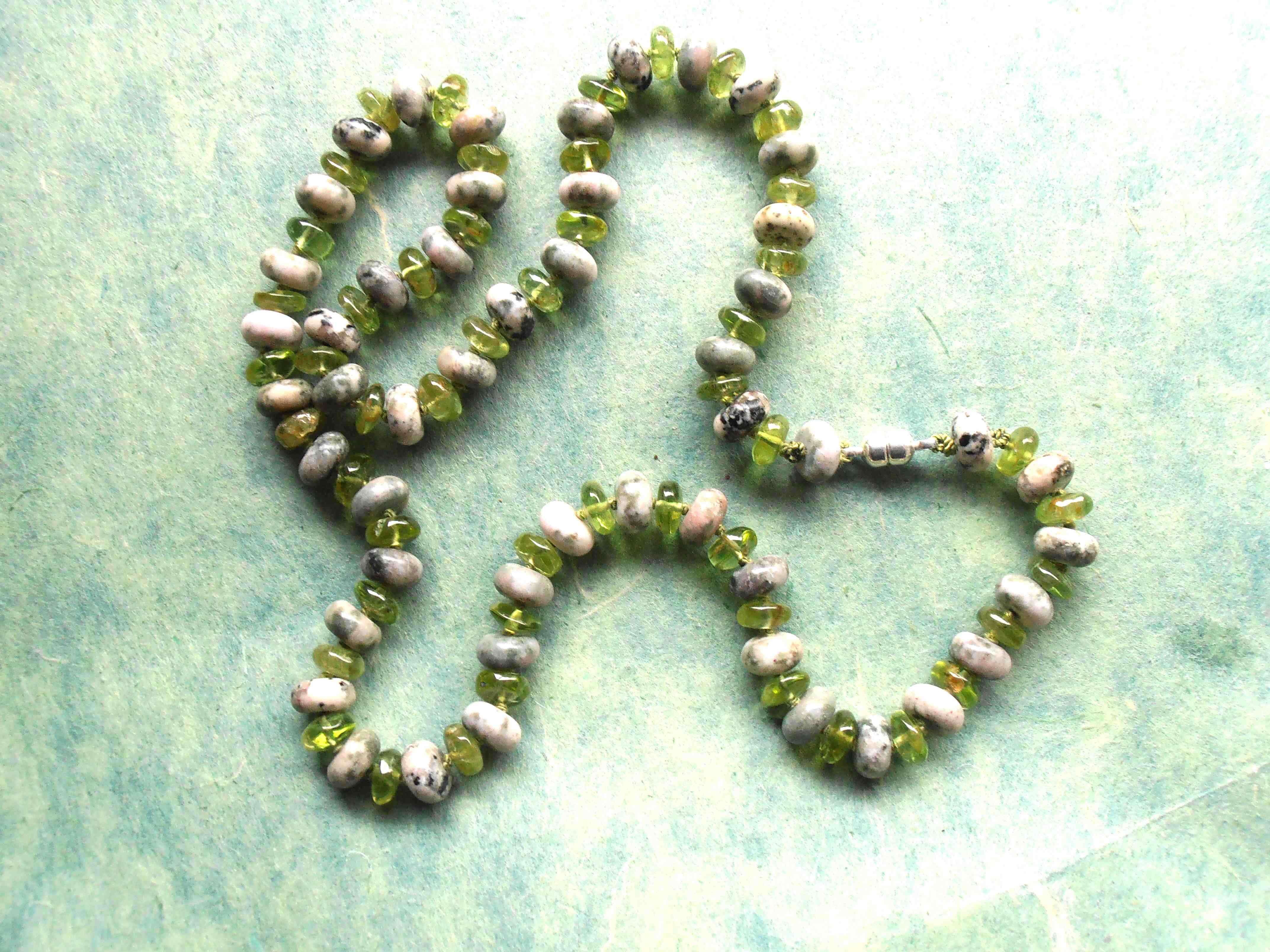
This one of a kind necklace features grassy green Peridot beads interspersed by a natural slightly pinkish stone from Northern Nevada with the trade name of “Lapis Nevada.” This grassy green color is characteristic of Peridot.
Associated with volcanic activity Peridot occurs in Hawaii, Pakistan, and Arizona among other locales.
In fact Hawaii is famous for its green Olivene beach. (Relative
Arizona is, by far, the most significant source of Peridot. There are few things more beautiful than a dish of dazzling green Peridot rough under the blazing Arizona desert sun.
Despite the obvious beauty of this unassuming green stone, good quality stones –-in small sizes– are usually relatively reasonably priced. (The per carat price of larger specimens of Peridot increases exponentially. Only a fraction of Peridot discovered can be cut into a stone with a weight of more than 3 carats. Five, Ten and even Twenty carat perfect Peridots do occur, but they are rare and commensurately priced.)
We love Peridot because –besides being a magnificent green– it is also a great mix and match stone.
The traditional birthstone for the month of July, Rubies have phenomenal name recognition.
In the United States rubies are probably the most popular and sought after member of the “Big Three.” (In the jewelry world the “Big Three” refer to the ever popular trio of Ruby, Sapphire and Emerald.)
Nevertheless, while nearly everyone knows the name of a Ruby (and many women and men want rubies) most people are shocked when they learn a few basic facts about rubies.
Rubies are Sturdy.
The precious price of many rubies has convinced generations of women that a ruby is inherently fragile and needs special care. In fact, one of the reasons rubies have traditionally been treasured is because they are amazingly sturdy. A fine –and even a not-so-fine– ruby can withstand daily wear for decades or centuries. (Fun fact… Thousands of years ago in India ruby was considered the gem of warriors and often inlaid in armor. Perhaps that explains the ongoing popularity of rubies in men’s school rings.)
Rubies are Sapphires.
If you feel confused you have the right to be. Sapphires are blue. (And actually a bunch of other colors. If you are interested in Sapphires we have a whole blog post about alternative Sapphire colors.) Rubies are red. However, both sapphires and rubies are Corundum. They are part of the same family in much the same way both Citrine (a yellow form of Quartz) and Amethyst (a purple form of Quartz) are part of the same family. Within the trade there is always a bit of a debate about how red a red sapphire technically has to be to be called a “Ruby” instead of merely a pink Sapphire. So… if you like the idea of a Ruby, but you are only shown very dark stones at a jewelry store –and you prefer something a little lighter or brighter– feel free to ask for a “pink sapphire.”
Rubies are Rare. Not exactly. Good rubies –with ideal red color and perfect transparency and relatively few inclusions– are rare. Natural red corundum is not that rare. In other words there are a lot of rubies that are not quite perfect. That doesn’t mean they aren’t pretty, or they aren’t goo. But perfection is rare in the natural world so a “perfect” natural ruby demands a premium that a less than perfect natural ruby does not.
This 2.11 carat faceted old-stock Burmese Ruby displays the classic dark red with just a hint of purple that traditionally leads many casual shoppers to confuse rubies for garnets at first glance.
Pearls are, traditionally the most popular birthstone for the month of June.
Want to learn more about the different types of pearls? Cultured? Natural? Freshwater? Saltwater? Tahitian? Click on the picture to read our quick and easy guide to the basics of pearls.
Ironically Pearls are not a stone. Or a gem. To be exact a pearl is a gemmoid. An organic product formed by a mollusk. A true “gem” is by definition inorganic.
As is the case with most “birthstones” Pearls have never been the sole “traditional” birthstone for the month of June. Until relatively recently –think 1910s– cultured pearls were NOT widely available and natural non-farm-raised pearls were wildly expensive. A good set of pearls in the late 1890s was literally equivalent in value to a Manhattan mansion. Not a townhouse, a mansion.
So in the 19th century milky-white Moonstones and creamy Chalcedony were popular as birthstones.
These Cultured Grey Tahitian Pearls offer a “different” look for the woman who doesn’t want basic white. (Although, to be fair, we have never thought there is anything “basic” about creamy white pearls.)
Today pearls are truly accessible. Lovely. Traditional. Wild. Modern. Whatever style you want a pearl can suit your personal style.
We love pearls, we are in a minor sort of way, pearl people. So we’ve written about pearls before. If you are interested in learning more about pearls be sure to browse our full website. And if you are interested in color check out this blog post from the Fall of 2016.
Emerald is the traditional birthstone of the month of May. The green variety of Beryl –Aquamarine is the blue variety of Beryl, Heliodore the golden yellow variety of Beryl– Emerald has been used in jewelry since before the pyramids were built.
It is the gem that comes closest to symbolizing Spring. The color of (American) money, the color of envy, the gem of love. Because, more so than any of the other “big” gemstones –in the jewelry world Emerald, Sapphire and Ruby are collectively known as the “Big Three” due to their persistent importance and popularity–you have to fall in love with an individual Emerald.
No two Emeralds of any size are identical. And two Emeralds of roughly the same weight and value may strike a viewer as radically different. Because, they often are radically different. They may be equally beautiful… but one you love and one you may not really love.
That said, like everything we love, Emeralds have their flaws.
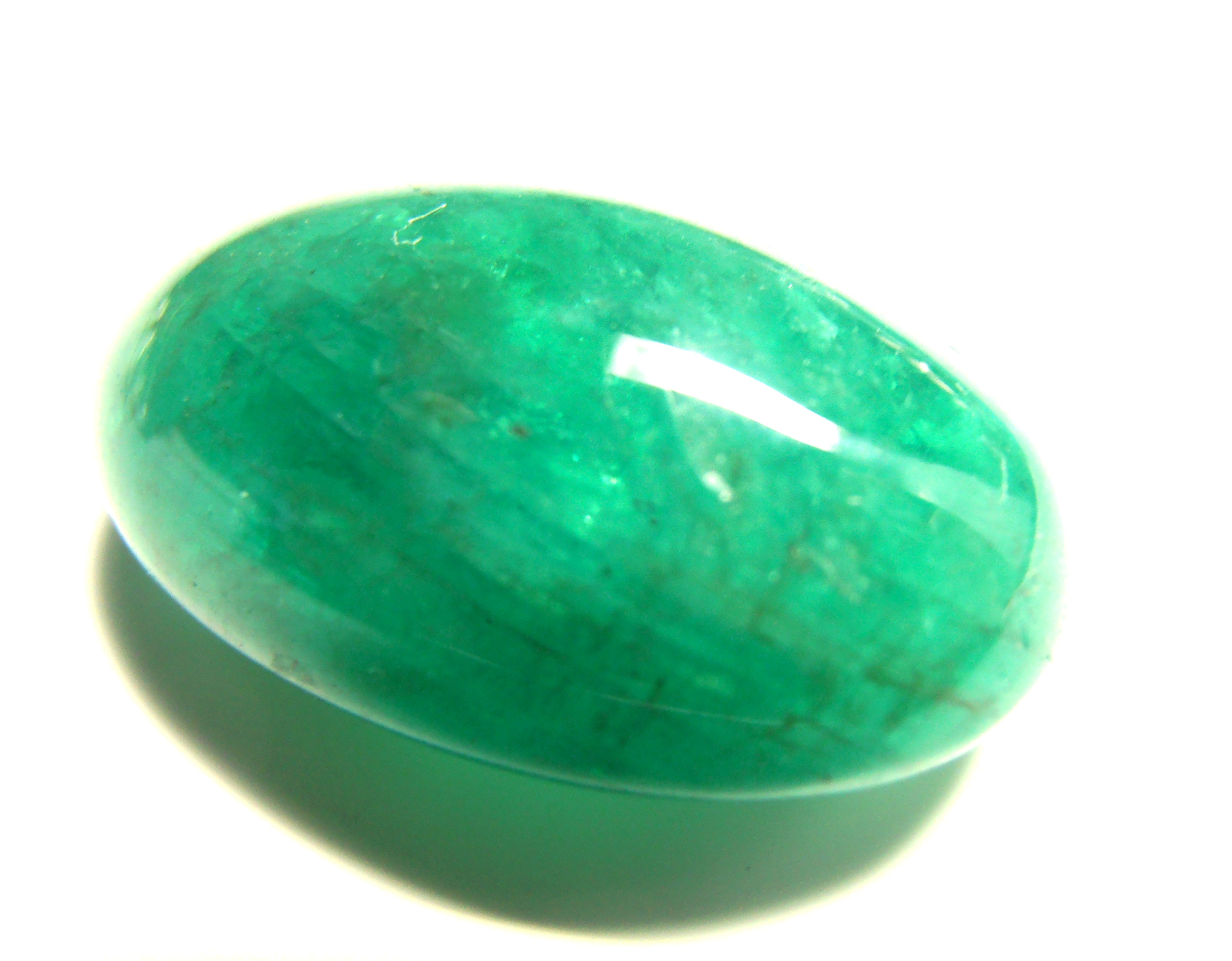
This close-up of a heavily included Emerald Cabochon seems to have a whitish cloud. It is likely the slightly whitish cloud in this natural Zambian Emerald is the result of a Calcite inclusion.
In fact, the flaws often contribute to their beauty. (“Flawless” isn’t a word we can use when describing a natural Emerald. The lack of flaws in synthetic Emeralds makes them noticeably different than natural Emeralds.)
In the interests of full disclosure we at N.C. Nagle Gems & Beads always believe in disclosing “inclusions” –but with an Emerald we also believe in marking a clear line between aspects of the stone that will make it more fragile, and characteristics that merely impact the appearance.
It is tempting to assume that an “Emerald” is always the glamorous nearly clear dark green that costume jewelers have been selling as an “Emerald substitute” for years. In fact, most Emerald isn’t all that clear and often displays a blueish or yellowish undertone. This large –it weighs over one pound– specimen is an Emerald. But its primary purpose is as a paperweight. So included it is nearly opaque and with numerous cracks and fractures it is a curious desk ornament rather than a precious jewelry adornment.
A crack or a fracture is something that you should worry about. An inclusion? Often an inclusion is a bit like a freckle… nothing to worry about. In fact, as a gem dealer I can get quite excited about certain types of inclusions. Some inclusions in Emeralds are impossible to fake and their presence automatically proves that the stone is natural. A good eye and and a goodly amount of experience and all that heavy equipment is just an accessory, not really a necessity.
Aquamarine, the March birthstone, is an elegant constant of the jewelry world. Nevertheless, Aquamarine can still surprise. And even shoppers who don’t think they like blue –or think they like something that is a little bluer than Aquamarine– sometimes find themselves falling in love with the “watery” cousin of the Beryl family.
By definition Aquamarine is blue. It is the blue form of Beryl. (The green form of Beryl is “Emerald” and the yellow form of Beryl is “Heliodor” etc.)
This one of a kind necklace features spheres of natural Aquamarine –blue with hints of yellow and green– interspersed with Zoisite mined in Nevada.
However, natural Aquamarine is rarely the intense blue people assume it should be. “Aqua – Marine” is a watery blue. In turns delicate –many people think Aquamarine is the ideal blue for a blonde to wear– and changeable. Untreated Aquamarine –most Aquamarine commercially available has been heat-treated to make the blue color more intense and more even– often displays a hint of green or a shadow of yellow.
We are particularly fond of the slightly greenish slightly translucent Aquamarine from Brazil. From a designer’s point of view it is the ideal “mixer” bead to combine with either an intense dark Malachite or a lighter brighter blue Turquoise.
While Aquamarine has been known and used as a jewelry stone for at least two-thousand years –the name Aquamarine was bestowed by the Romans– it has only been treasured as a birthstone since the 19th century when Victorians fell in love with a stone that could be faceted or cut en cabochon. (And the mineral wealth of Brazil began to make the jewelry world significantly more colorful.)
Amethyst, the February Birthstone, sometimes seems like the stone jewelers have been using forever. It is a “staple” of the jewelry industry… And, like any staple, anything that is always there, beautiful but in the background, Amethyst often doesn’t get the respect it deserves. But Amethyst isn’t just a staple of the jewelry industry, it is more like that lost Old Master hanging in a shadowy hallway at grandma’s house. Not forgotten exactly, but under appreciated until a stranger stops in shock at the wonder of it.
So perhaps we owe Amethyst –and all the February babies– the honor of taking a look at our old friend Amethyst with a stranger’s eyes.
From a scientific point of view there is nothing spectacularly odd about the origin of Amethyst. Amethyst is a Quartz. A Silicate. (Silica is one of the most common minerals on Earth, and it is also one of the most useful substances on Earth.) By definition Amethyst is the purple Quartz. If it is Quartz and it isn’t purple (or at least slightly purplish) it is not Amethyst. By definition there is no such thing as “Green Amethyst.” (If it isn’t purple it has a different name… For instance, “Yellow Quartz” is Citrine.)
Because Amethyst is a Quartz and can thus be found in many different locations throughout the world, Amethyst has an old history of use in jewelry and over the past three thousand years has been set in expensive “Court Parures” as well as more everyday pieces (for those of us who do not socialize with the Emperor Napoleon’s well-dressed sisters).
Amethyst can be either a dark rich purple or a lighter shade of lavender. The February Birthstone was used in jewelry for centuries before faceting became common. The elongated barrel shaped Amethyst beads in the necklace are reminiscent of the beads made and worn by the Ancient Egyptians of Cleopatra’s Age.
While Amethyst was used by Egyptians for centuries before Rome grew into a mighty Republic (and then an even mightier Empire), it is the Greeks and the Romans who gave Amethyst its origin story. To the Romans Amethyst was a beautiful girl who had dedicated herself to Artemis, Virgin Goddess of the Hunt, Protectoress of the Innocent. To escape the unwanted attentions of the lecherous Dionysius, God of Wine, Amethyst begged her Protectoress to make her untouchable. Artemis obliged by the beautiful girl by turning her into a clear piece of Quartz. Supposedly the God of Wine, guilt stricken that his unwanted attentions had driven the pure Amethyst to such desperate measure poured a libation of purple wine over the clear Quartz and gave Amethyst her color for all time.
Whether Amethyst was ever a beautiful girl it is not our place to say. But Amethyst is still a uniquely beautiful stone.
The dark beauty of Amethyst makes it an ideal “mixer” stone for multi-color jewelry. During the 1890s in the United States and Britain jewelry incorporating Amethyst, Emeralds and Pearls became a popular and discreet way for ladies to signal their commitment to women’s suffrage. In the language of stones Green (Emerald), Violet (Amethyst) and White (Pearls) spelled “Give Votes to Women.”
We think Amethyst in all its glory is still a wonderful choice for jewelry. And a perfect February Birthstone –and gift– for all the February babies out there.
While we love the beauty of cut and faceted Amethyst… even in its “raw” form Amethyst is beautiful. This necklace features spheres of polished Turquoise and unpolished “raw” Amethyst points.
Garnet has been the traditional birthstone for the month of January for centuries…. However, while most months have “alternatives” to the “traditional” birthstone, January’s alternatives are also Garnet.
Not to delve too deeply into the science of the garnet family, garnets are an aluminum-silicate and thus are extremely complex. (I had to map the formula by hand in college… most time-consuming test question ever!) And… because they are so complex there are actually a number of different species and varieties of Garnets. Some aren’t suitable for jewelry use –some simply aren’t large enough to do much with other than admire them under a microscope– but in general if you are willing to do a little searching you can find about four different garnets that are suitable for jewelry. And… they aren’t all red… or even reddish.
Almandine–a.k.a. Almandite– is the “classic” red garnet most people probably think of when they think of Garnet. When it is the reddest and bloodiest possible color Almandine actually looks a lot like good quality Burmese Ruby. (There are a couple of stories of people accidentally giving away grandma’s “old fashioned” “Garnet” brooches and later finding out they were actually extremely valuable rubies.)
Pyrope is another bloody red garnet. (Some people label the deep red of Pyrope “fiery” –I’ve always been a little ambivalent about Pyrope. Quite often it is such a saturated dark red that it appears almost black.)
Rhodolite is a mid-range reddish garnet. (Sometimes a tad on the purplish side of the red spectrum.) Often incredibly pretty it is in general considered the workhorse of the jewelry world. For jewelers Rhodolite is a basic the way butter is a basic for a French chef.
Spessartite and Hessonite are where things start to get a little more interesting. And a lot less red. Spessartite and Hessonite are the members of the Garnet family that slide into the realm of “cinnamon” colors. Some are a brilliant orangey yellow. Often heavily included these stones are highly sought after even when included because of the dazzling combination of color and refraction. (When faceted they have a tendency to be quite brilliant.) Personally I love both Spessartite and Hessonite when faceted as well. Color-wise they have a tendency to look a lot like Baltic Amber.
Tsavorite is the oddest member of the Garnet family that can generally be found in (high-end) jewelry. It is a flashy bright green garnet native of Africa (some Tsavorite can be found is Russia as well). Good quality Tsavorite has a tendency to be pricey… And, like all garnets it tends NOT to be the sturdiest stone for use in rings. (And people love to put Tsavorite in rings…) We think Tsavorite is beautiful in earrings, but its rarity –and the broad range of greens it comes in– makes it difficult to match pairs of any size. (We occasionally have a nice Tsavorite for use as a pendant or accent stone on an artist piece… but we probably haven’t had more than one good matched pair in the last decade.)
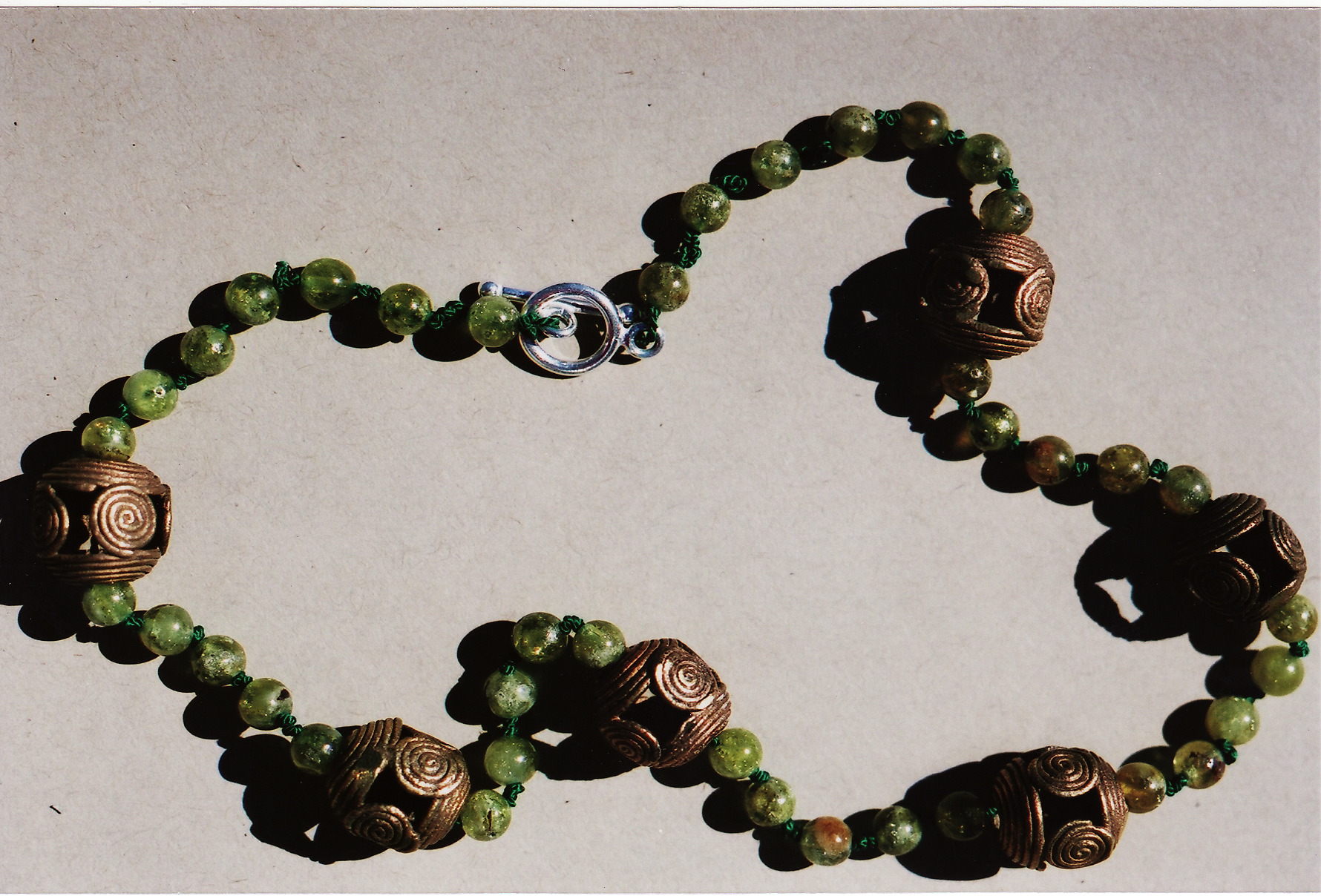
This necklace features natural green Grossular Garnets from Africa with vintage handmade brassbeads (also from Africa). Note the bright mix of pale and dark greens apparent in these beads….
Turquoise has been the commonly accepted birthstone for the month of December for well over four hundred years now. However, Turquoise has been mined, used and treasured for thousands of years and has a history that predates the idea of a “December birthstone,” birthstone lists, and lists in general. (In fact, humans began mining the precious blue stone long before the earliest Egyptians began to experiment with hieroglyphics.)
Regardless, like all great stories the story of Turquoise as a birthstone doesn’t really begin with the beginning. Instead it begins with a twist of fate, a bad translation, an unfortunate inability to read a map and an overwhelming desire for the most beautiful blue stone in the world.
It has been well over a century since anyone in the western world thought of turquoise –or any other stone– as a pigment. But a few hundred years ago blue was one of the rarest and most sought after colors. A cloth merchant could make do with indigo, but a painter needed Lapis Lazuli or Turquoise.
For the painters of Renaissance Italy the best blues came from the East. Or, more exactly, from traders who brought their precious cargoes from Constantinople –Jewel of the Ottoman Empire– to Venice. Cloth wrapped bundles of precious dusty blue pebbles would then make their way into the mortar and pestles of the painters who ground their own pigment. (And often demanded payment upfront for a commission that involved a lot of blue.) Lapis Lazuli was the dense midnight blue. Turquoise was a brighter blue. Light like the endless sky over Rome.
If the traders knew the origin of the paler blue stone they never bothered to tell the painters. Instead they called it “Turk’s Stone” –a stone they had brought from the land of the Turks. “Turk’s Stone” became, inevitably, “turquoise.” And, for a few hundred years no one much thought about what, exactly, Turquoise was. (Or even where it really came from. In fact there issome Turquoise that has been discovered in modern day Turkey, nevertheless, for roughly five thousand years the vast majority of Turquoise traded throughout Asia and Europe came from Persia –or the Sinai Peninsula–not Anatolia.)
Most of the early traders were far more concerned with the quality of the blue material they had found and where they had found it than they were with figuring out why the stone we know today as Turquoise existed. (In fact, Turquoise, like Malachite, is a copper associated mineral and examples of Turquoise have been found in copper rich regions in Persia, China, Tibet, Egypt, Poland, Mexico and the United States.)
Both the green and the blue beads in this one of a kind necklace are copper associated minerals. The green is natural Malachite from Africa. The blue is a natural Turquoise from an Arizona mine known as “Sleeping Beauty.”
Today, of course, when we think of Turquoise we almost always think of the American Southwest. For well over a century a fine –or sometimes not so fine– piece of Turquoise jewelry has been the preferred souvenir of a trip to the American West.
Sadly much of the Turquoise jewelry now sold in the Southwest does not actually incorporate real American Turquoise. Synthetics and simulants are cheap and readily available. The colors more even and matchable than natural material. (And usually far far less expensive.) Of course…. all of the stones sold as Turquoise by N.C. Nagle are genuine Turquoise. We believe in full disclosure of all treatments. And… not only can we tell you whether our Turquoise ahs been treated or not we can often tell you which exact mine it came from!
Turquoise, Shell and Coral. All the colors are natural… but only the blues and greens are Turquoise. (Although you may find “purple” or “red” “Turquoise” on the market that material is either not Turquoise or has, sadly, been dyed.)
But just because a stone seems odd or bright does not mean it isn’t real. Natural Turquoise is a true gift of nature and, like all the best gifts, it can be a bit surprising. So… if you are a December baby and feel a little blue because you don’t like blue and your December birthstone is “Turquoise” never fear…. there is natural green Turquoise as well. And the natural blues can range from an intense deep blue to a pale sun-washed skyblue.
I’m not a big fan of the whole birthstone thing. Partly because it seems as if I am always explaining the list. At first it seems simple –doesn’t it always? Inherently birthstones should be simple. For me, it is always easiest to begin the list with the November birthstone, Topaz, and the other November birthstone, Citrine. Yes, there are two.
The idea of birthstones should be so simple. A stone assigned to a particular month. If you know someone’s birthday you can find a thoughtful gift. But most months have more than one accepted birthstone. (Some months have a lot of “birthstones” –the reasons for varying lists vary from problems of availability, to problems of translation, to simple fashion.)
November’s two birthstones make a certain amount of sense. Topaz and Citrine look a lot alike.(Yes, I know, the Topaz you may be most familiar with is blue. However, the very rare and beautiful golden Topaz that is meant to be the November birthstone does look a lot like the yellow variety of Quartz known as Citrine.)
But Golden Topaz is rare, and often quite expensive. Citrine is less rare, less expensive, and often very beautiful. (Even better, while it is often hard to find a large Imperial Topaz of cuttable quality, large Citrine is relatively easy to find.)
Rough Citrine can be just as beautiful as faceted or polished stones. This necklace features rough chunks of light yellow Brazilian Citrine interspersed with discs of blue Turquoise from northern Nevada.
Both are –or can be, natural stones always come in a range of shades– a lovely yellow. Citrine in particular can range from a near limey shade of lemon to a dark and smokey color reminiscent of the last inch of cognac from a very old bottle.
So happy birthday Citrine and to all November babies… Remember you have two options… And a range of yellows…
Oh… And if you are looking for a custom one of a kind necklace featuring Citrine we have a few options…
If you like the rough and wild look our Rough Citrine and Lapis Lazuli cube necklace might be an ideal statement choice…
And if you prefer the sparkle of a faceted stone our faceted Citrine and Turquoise necklace would be ideal for clean colors… Bright blue and golden sunlight! Bright Faceted Citrine and Turquoise Necklace